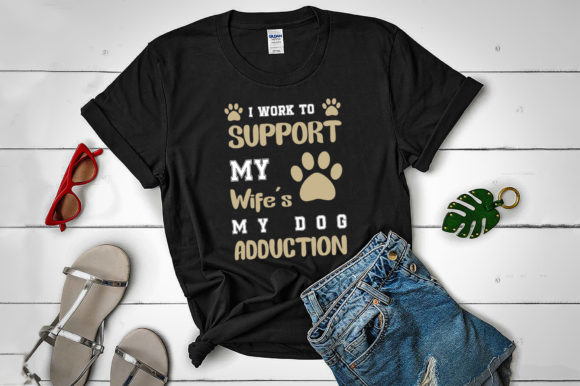
I Work to Support My Wife & My Dog
A Designer’s First Look: Warm, Witty, and Immediately Relatable
When I opened I Work to Support My Wife & My Dog, my first thought wasn’t about stitch count or file format—it was about tone. This isn’t a shouty slogan or a sarcastic meme turned embroidery file. It’s warm, grounded, and quietly confident. The phrasing feels conversational, like something you’d say with a grin while unloading groceries—not a forced “vibe” but real-life pride in partnership and companionship. Visually, it reads as clean and friendly: balanced spacing, moderate letter height, no excessive flourishes or fragile serifs. That tells me this machine embroidery design was built for legibility first—especially important when stitching on textured fabrics like canvas tote bags or loopback sweatshirts.
Where It Shines: Real Projects, Real Reactions
Last week, I used I Work to Support My Wife & My Dog to embroider a set of cotton twill aprons for a local café owner who wanted staff gifts that reflected her team’s values—family, loyalty, and lighthearted authenticity. We stitched it on the left chest, 3.5 inches wide, using medium-weight cutaway stabilizer and matte poly thread. The result? Instant smiles. Customers noticed it. Staff wore it proudly. No one squinted to read it. That’s the quiet power of this design: it lands emotionally *and* technically.
It works especially well for custom apparel where personality matters more than polish—think relaxed-fit crewnecks, organic cotton tees, or linen pillow covers for nursery decor. As a sweatshirt embroidery piece, it holds up beautifully at 4–4.5 inches wide. On baby onesies? I’d size down carefully (more on that below), but the sentiment translates warmly—ideal for new-parent gift bundles. And yes, it’s been a steady seller for Etsy sellers listing embroidered patches and tote bag designs aimed at dog-loving spouses and partners.
Where to Pause—and Why
This isn’t a one-size-fits-all embroidery file. Its charm lies in its simplicity, but that also means it needs thoughtful placement. Avoid using I Work to Support My Wife & My Dog on curved surfaces like caps unless you’re confident in your hooping technique and have tested it on scrap fabric first. The phrase’s length and even rhythm don’t adapt easily to tight crowns without subtle distortion.
On dark fabric, contrast is non-negotiable—test thread colors in both black and white mockups before production. On thin or stretchy fabric (like jersey knits), stabilizer choice becomes critical: skip tear-away alone; go for cutaway + topping if you want crisp lettering. And while the design avoids tiny details, those lowercase “i” dots and the ampersand (&) are small enough to blur if stitch density is too low or thread tension is off. Always inspect them under magnification after your first test run.
Small Hoop? Think Twice
If you’re limited to a 4x4 hoop, this design will likely need resizing—or better yet, splitting into two lines. Don’t force it. Crowding letters compromises readability and increases thread breaks. For baby embroidery or cap fronts, consider whether a shortened variant (“My Wife & My Dog” or “I Work for Them”) might serve your product goals more cleanly.
What It Adds to Your Finished Product—Beyond Stitching
I Work to Support My Wife & My Dog elevates handmade product perception not through complexity, but through resonance. When customers see it on a kitchen towel or holiday gift box, they don’t just register text—they recognize shared experience. That builds trust faster than any logo ever could. For craft business owners, it supports brand consistency by reinforcing warmth and authenticity across multiple items: matching tea towels, embroidered patches, and printable mockups for social media listings all feel like part of the same thoughtful collection.
It also strengthens giftability. Unlike generic quotes, this phrase invites personal connection—making it ideal for wedding gifts (for the groom who adores his wife and pup), Father’s Day sweatshirts, or “just because” personalized gifts from small shop owners who know their customers by name.
Practical Designer Notes Before You Stitch
- Always test first—on scrap fabric matching your final product’s weight, texture, and color.
- Check thread color contrast on both light and dark backgrounds before committing to bulk production.
- Review stitch density: Too sparse = gaps in fill stitch; too dense = stiff, bulky lettering on soft fabrics.
- Confirm hoop size compatibility—if your machine maxes out at 4x4, ask the seller if a scaled version is available.
- Inspect small details closely: ampersand shape, dot clarity on “i”, spacing between “Wife” and “&”. These define professionalism.
- Use proper stabilizer—cutaway for stable wovens, tear-away + topping for knits or delicate surfaces.
- Verify licensing: Since the description says “You can use this file for the product to be printed,” confirm whether commercial embroidery or resale of finished items is permitted—especially if you’re an Etsy seller or wholesale partner.
Final Thought: A Design That Earns Its Place
I Work to Support My Wife & My Dog isn’t flashy—but then again, the best T-Shirt Designs rarely are. It’s a quiet, confident piece of design assets that earns its place on apparel, home goods, and personalized gifts not by shouting, but by speaking clearly, kindly, and unmistakably. Whether you’re stitching a single custom tote bag or scaling up for a boutique’s seasonal line, this embroidery file delivers emotional impact *and* technical reliability—if you treat it with the same care you’d give any client-facing design. That balance is rare. And worth holding onto.