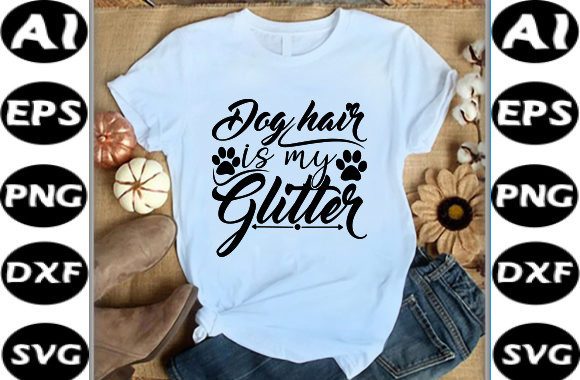
DOG T-shirt Design, Dog Hair is My Glitte
A Designer’s First Look: Playful, Punchy, and Unapologetically Pet-Loving
When I opened DOG T-shirt Design, Dog Hair is My Glitte, my first thought wasn’t “cute”—it was “confident.” The phrase lands like a wink from a fellow dog parent who’s vacuumed glitter *and* fur off the same rug. Visually, it’s clean and bold: rounded sans-serif lettering with subtle bounce, balanced negative space, and that clever visual metaphor—dog hair as glitter—immediately readable at a glance. It doesn’t try to be delicate or intricate; instead, it leans into charm through rhythm and attitude. That makes it ideal for embroidery projects where personality matters more than precision: think tote bags for vet clinics, sweatshirt fronts for rescue volunteers, or baby onesies where humor softens sentiment.
Where This Design Truly Shines in Real Embroidery Projects
I tested DOG T-shirt Design, Dog Hair is My Glitte on a medium-weight cotton twill tote bag—and it held up beautifully. The letterforms are generous, with no tight corners or micro-details that vanish under satin stitch. As a machine embroidery design, it translates well across common applications: embroidered patches (great for iron-on dog-walker badges), sweatshirt embroidery (especially on heather grey or navy), and even tea towels where legibility matters after repeated washes. For Etsy sellers and small shop owners, this is a smart digital embroidery file to pair with neutral apparel—it adds instant character without overwhelming the garment. I also stitched it onto a lightweight canvas apron for a local pet bakery pop-up: customers smiled, snapped photos, and asked where to buy the shirt. That kind of organic engagement? That’s the mark of a design that works *with* your product—not just on it.
Where to Pause and Plan Before Stitching
While DOG T-shirt Design, Dog Hair is My Glitte is highly adaptable, it’s not universally foolproof. On stretchy fabric like jersey tees, you’ll need cutaway stabilizer—not just tear-away—to prevent puckering around the curves of the letters. On dark fabric, avoid light thread unless you’re adding an underlay; the design’s openness means background bleed can mute contrast. And if you’re stitching on curved surfaces—like the front of a structured cap—the topmost curve of the “G” or “t” may need slight digitizing tweaks for consistent stitch density. Also, while it’s labeled for Print Templates, remember this is fundamentally a Graphics asset built for screen printing or digital mockups—not direct embroidery. Always verify whether the SVG or PNG includes stitch data or if you’ll need to auto-digitize or hire a digitizer for true embroidery use.
Design Integrity Meets Customer Trust
What makes DOG T-shirt Design, Dog Hair is My Glitte feel trustworthy isn’t just its aesthetic—it’s how clearly it communicates intent. When customers see this on a handmade product, they instantly grasp tone, audience, and care level. That builds trust faster than any description. A personalized gift with this design feels intentional, not generic. A boutique sweatshirt line using it reads cohesive—not like a grab-bag of clipart. But that only holds if execution matches expectation. If stitch density is too low on thin fabric, or if thread colors clash with the base garment, the playful message gets muffled. So yes—it elevates brand consistency, but only when treated with the same attention you’d give a custom-drawn logo.
Practical Notes Every Embroidery Designer Should Run Through
- Test first on scrap fabric matching your final product’s weight and stretch—especially for baby embroidery or holiday embroidery where softness and safety matter.
- Check thread color contrast in both natural and artificial light; what reads bold on screen may fade on oatmeal linen or charcoal fleece.
- Review stitch density before hooping—if the file lacks fill-stitch guidance, assume moderate density works best for apparel durability.
- Confirm hoop size compatibility; this design fits comfortably in a 4x4 hoop, but double-check the actual dimensions in your software before scaling.
- Inspect small details like the dot over the “i” or spacing between “Dog” and “Hair”—they should remain distinct, not merge during stitching.
- Test black-and-white mockups to assess silhouette strength—this design relies on shape recognition, not shading.
- Compare light/dark fabric backgrounds in your workflow; some thread palettes work better on one than the other.
- Use proper stabilizer: cutaway for knits, medium-weight tear-away for stable wovens, and optional topping for textured fabrics like terry cloth.
- Verify licensing before selling finished products or reselling the digital embroidery file—especially for commercial embroidery or craft fair products.
Final Thought: A Design That Fits Like a Well-Worn Leash
DOG T-shirt Design, Dog Hair is My Glitte isn’t flashy—but it’s dependable. It doesn’t shout; it grins. As a craft business owner or Etsy seller, you’ll appreciate how easily it slots into your existing workflow: no redrawing, no overthinking, just confident, relatable charm stitched cleanly. It works because it respects the medium—embroidery isn’t about pixel-perfect replication, it’s about clarity, texture, and emotional resonance. Use it on a pillow cover for a dog-loving friend, embroider it onto a holiday gift for a new puppy parent, or feature it in your printable mockup gallery to attract fellow makers. Just remember: great design is only half the story. The other half is thoughtful execution—and that starts with knowing exactly what this file brings to your next embroidery project.